
Comparisons
Best Swapcard Alternatives
Compare Swapcard alternatives on networking, AI, pricing, and fit.
Subscribe for insights on AI- powered event apps, engagement strategies, and to learn more about how event teams are driving measurable results.


The Short Version
Bizzabo bundles registration, websites, a mobile app, and onsite tools in one system, which works for B2B marketing teams that want a single login. Reviewers mention templates that won't bend to their brand, separate tools for agendas, and a long learning curve. This guide compares Bizzabo with Amego, Cvent, Stova, Swapcard, EventMobi, Whova, and Eventbase, including Amego's mobile event app.
Bizzabo pitches itself as an Event Experience OS: one system for registration, event websites, a mobile app, onsite tools, and event data. For B2B marketing teams that want everything under one login, that pitch lands.
The trouble usually starts in the details. A reviewer on G2 mentioned paying for a separate agenda tool because the built-in session experience did not fit their event. Others describe templates that will not bend to their brand, or a platform with so many options that new team members need weeks to get comfortable.
If that sounds familiar, this guide compares seven Bizzabo alternatives worth evaluating in 2026, what each one does well, where each one falls short, and which kind of event it fits. We are Amego, so we are on the list. Where another platform is the better fit, we say so.
Pricing reflects vendor pages and review-site listings as of 2026 and changes with attendee counts and negotiated terms. Use the table to build a shortlist, then test each vendor against your real agenda.
Bizzabo is an event management platform built mainly for B2B marketing teams. It covers registration and ticketing, event websites, email, agenda management, a branded mobile event app, networking, virtual and hybrid events, onsite check-in, and Klik smart badges that track in-person interactions. Bizzabo says a customized event app can go live in the app stores in as little as three weeks.
Its strongest selling point is consolidation. Event data, engagement, and attribution live in one system that connects to marketing tools like HubSpot, Marketo, and Salesforce, which matters to teams that report events in pipeline terms.
Bizzabo uses seat-based annual pricing with a menu of premium add-ons. According to Capterra, the Event Experience OS starts at $17,999 per year, billed annually with a three-user minimum, and Klik SmartBadge pricing is custom. Reviewers on Capterra and GetApp describe the base pricing as transparent but note that advanced features and customizations add cost.
Bizzabo is a well-reviewed suite, so a top-line rating will not decide this. The detailed G2 scores tell a clearer story: verified reviewers rate Amego higher than Bizzabo on all six measures below.
What G2 reviewers say
Rated Higher by the Event Teams Who Use It
Here's how verified G2 reviewers rate Amego and Bizzabo on G2.
Attendee networking
vs. 81% for Bizzabo
Likely to recommend
vs. 88% for Bizzabo
Overall relationship score
vs. 81% for Bizzabo
Meets requirements
vs. 85% for Bizzabo
Ease of admin
vs. 88% for Bizzabo
Ease of setup
vs. 87% for Bizzabo
Source: G2 user satisfaction ratings, 2026. Percentages reflect each product's verified G2 reviews; Amego has fewer reviews than Bizzabo.
The biggest gaps are attendee networking (96% vs. 81%) and likelihood to recommend (100% vs. 88%). Networking is the piece attendees feel first, and recommendation reflects how reviewers feel after the event is over. Amego also leads on ease of admin (98% vs. 88%) and ease of setup (97% vs. 87%). G2 named Amego a Leader in its Mobile Event Apps Grid for Summer 2026, with 100% satisfaction scores for performance and reliability and for API and integrations.
Most Bizzabo reviews are positive, and its support team gets regular praise for fast responses. The reasons teams leave tend to be specific.
Limited customization is the most common complaint theme in Bizzabo's G2 reviews, covering event website templates, design options, and reporting. For a flagship customer conference, a template look can work against the brand the marketing team spent a year building.
Reviewers praise how much Bizzabo can do, then add that the sheer number of options takes time to learn. G2 reviews also flag steep learning curve, not intuitive, and complexity as recurring themes. That cost shows up every time a new coordinator joins the team.
The base subscription covers a lot, but reviewers mention that advanced features, customizations, and onsite hardware cost extra. A platform priced as all-in-one can end up looking like a stack of line items.
Because Bizzabo covers the whole event lifecycle, the attendee app is one part of a much bigger product. One G2 reviewer said their team pays for Sched to handle the schedule and sessions rather than use Bizzabo's own event experience. Teams that judge an event by what attendees do onsite often want a platform where the app is the main product.
Best Bizzabo alternative for: Enterprise events that want a branded app with proactive AI
Amego is an attendee experience platform built by event pros. It supports events from 500 to 100,000+ attendees, and teams at Atlassian, Cloudflare, Google Cloud, ServiceNow, and Palo Alto Networks run their events on it. Where Bizzabo spreads across the full event lifecycle, the Amego platform goes deep on what happens after someone registers.
Sidekick is built into the app. Amego's Sidekick combines conversational AI with proactive attendee guidance. It answers questions about event content while recommending relevant sessions, networking opportunities, and experiences based on attendee and event context. That can mean telling an attendee their next session starts in ten minutes, flagging a gap in their agenda worth filling, suggesting a peer worth meeting, or pointing out a sponsor demo nearby.
Amego's networking tools include AI matchmaking, attendee profiles, messaging, 1:1 meeting booking, and QR contact sharing, so attendees move from browsing a directory to booking real conversations.
Teams manage content, branding, targeted notifications, and analytics in Amego Admin, and changes go live in the app right away. Amego Studio, an in-house design team, builds custom screens when a template will not do. The app runs under your own app store listing.
Amego integrates with Cvent, RainFocus, Swoogo, Braindate, CrowdConnected, ExpoFP, and other enterprise systems, so registration data flows into the app without manual exports. Sponsors get lead scanning with custom qualifying questions, and Quest gamification can send attendees to specific booths.
Cloudflare evaluated five event apps before choosing Amego and reached 98% app adoption across its global events. Atlassian runs 20+ events a year on Amego, and Palo Alto Networks uses it to scale its global events while keeping the brand consistent. Amego is SOC 2 Type II and GDPR compliant.
Where Amego is not the right fit: Amego does not do registration, ticketing, or event websites. It connects to the system that does. If you want a single vendor for every step, Bizzabo or Cvent is simpler.
Best for: enterprise events, user conferences, and global programs where brand, attendee guidance, and sponsor ROI all matter.
Amego has an MCP server that lets event teams work with their Amego data from the AI assistants they already use, including Claude, ChatGPT, and Codex. Access mirrors each user's Amego account permissions and stays limited to their own organization and events, and connecting Claude needs approval from an Amego admin. It is a different job from Sidekick, which guides attendees inside the app: the MCP server is for the planners and organizers behind the event.
Best for: Large enterprise programs that want venue sourcing in the same system
Cvent is the most common full-platform alternative to Bizzabo. It covers registration, event marketing, hotel and venue sourcing, attendee management, and reporting, and its Attendee Hub provides the event app. The University of Washington's published Cvent rates list Attendee Hub plus the event app at $7 per registrant, per event, on top of a $4.25 per-registrant platform fee.
Watch out for: reviewers describe a steep setup curve and limited layout customization in the attendee app, so it can trade one set of customization limits for another.
Best for: organizations running large portfolios of events that want sourcing, registration, and the app under one contract.
Best for: High-volume, repeatable event programs
Stova is the combined company formed from Aventri, MeetingPlay, and eventcore. It offers end-to-end event management with registration, agendas, badges, reporting, and an event app known for its design, which makes it one of the closer like-for-like Bizzabo competitors.
Watch out for: reviewers mention a significant setup learning curve and a higher subscription cost, and some long-time Aventri customers have questioned support quality since the merger.
Best for: organizations running many similar events a year that want one end-to-end system.
Best for: Trade shows and exhibitions built around meetings
Swapcard focuses on AI matchmaking between attendees, exhibitors, and sponsors, and large exhibition organizers like Informa and Clarion use it. Capterra lists its engagement platform from $610 per user per year, with registration priced separately.
Watch out for: subscriptions are annual, and some users report setup complexity for multi-track agendas.
Best for: exhibition organizers whose revenue depends on buyer and exhibitor meetings.
Best for: Associations and mid-market teams that want published pricing
EventMobi is a modular platform covering registration, check-in and badges, lead capture, a mobile app, and virtual events. Its pricing page lists per-event pricing from $3,000 and annual pricing from $8,900 per year with unlimited events, which is a fraction of Bizzabo's starting price.
Watch out for: reviewers mention an interface that can feel dated and agenda ordering that gets tedious at scale.
Best for: associations and smaller teams running several events a year on a predictable budget.
Best for: Academic and association conferences
Whova combines registration with a well-liked attendee app, community board, and networking tools. Attendees tend to get comfortable with it quickly, and the app is custom-quoted per event.
Watch out for: Whova's AI Companion is a built-in writing tool rather than an attendee assistant, and pricing is quote-only. For a deeper look, see our guide to Whova alternatives.
Best for: associations and academic conferences where attendee community matters more than brand control.
Best for: Massive flagship and consumer-facing events
Eventbase powers apps for some of the largest events in the world, including CES, SXSW, and Microsoft Ignite. G2 reviewers rate it 4.8 out of 5 and highlight design quality and scalability.
Watch out for: pricing reflects a full-service enterprise model, which can be more than a portfolio of smaller events needs.
Best for: one or two flagship events a year with 50,000+ attendees and a large brand budget.
Here is how Amego and Bizzabo compare on the features buyers ask about most, on the rows we track across the category.
Based on public vendor pages and review sites as of November 2026. "Not listed publicly" means we could not find it on the vendor's public pages, not that it is missing, so confirm details with each vendor before you decide.
| Feature | Amego | Bizzabo |
|---|---|---|
| AI companion in the mobile app | ✓ Yes. Sidekick | Yes. Bizzy AI is an in-app guide launched in June 2026. |
| AI guide on the event website | ✓ Yes. Sidekick Spark, with a free plan | No. |
| MCP server for Claude, ChatGPT, and other AI assistants | ✓ Yes. Amego MCP server, available to Amego users | Partial. Its Developers Hub mentions a read-only MCP server, with no tools, setup, or availability stated. |
| Gamification | ✓ Yes. Quest challenges | Sold as an add-on. Needs Klik hardware. |
| Offline access | ✓ Yes. | Partial. Through Klik. |
| Offline lead scanning | ✓ Yes. | Yes. Through Klik. |
| Works with any registration platform | ✓ Yes. Cvent, Swoogo, RainFocus, Stova, and Bizzabo integrations | No. Bundled with Bizzabo registration. |
| Public pricing | ✓ Yes. Published on the pricing page | Partial. From about $17,999 per year on Capterra and G2, not published by Bizzabo. |
| Free plan or free trial | ✓ Yes. Free Sidekick Spark plan | No. |
| Mobile app included in the base price | ✓ Yes. Included in Base and Elevate; container app and Studio cost extra | Not listed publicly. |
Most event platforms check the same boxes on a feature grid. These are the questions that separate them in practice.
For a broader view of the market, see our guides to the best event apps of 2026 and the best event management platforms.
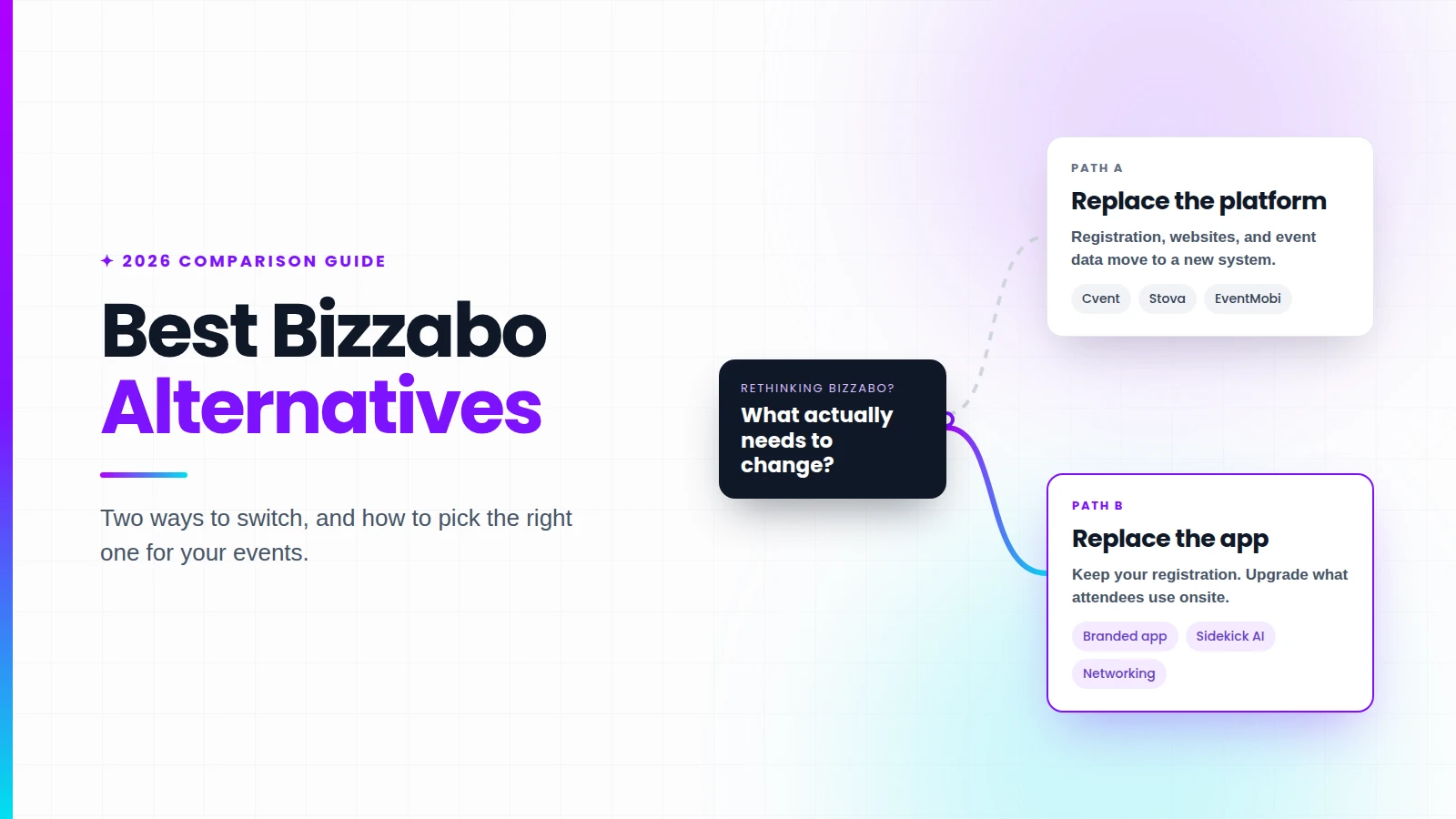
Teams evaluating event platforms like Bizzabo often frame the decision as all or nothing. In practice there are two separate choices.
If the problem is registration, websites, and marketing data, you are shopping for another full platform, and Cvent or Stova belongs on the shortlist. If the problem is what attendees experience once they arrive, such as a generic-looking app, an agenda that needs a workaround, or networking nobody uses, you may only need to replace the attendee layer.
That second path is where Amego fits. It connects to the registration system you choose and owns the onsite experience: the branded app, Sidekick, networking, notifications, and sponsor tools. Your marketing ops team keeps the registration workflows it trusts, and attendees get an app built around them. For more on how registration platforms compare, see our guide to the best event registration platforms.
Want to see your event in a fully branded app with Sidekick? Book a demo and we will walk through it using your own agenda.
The most common Bizzabo alternatives are Amego, Cvent, Stova, Swapcard, EventMobi, Whova, and Eventbase. Amego fits enterprise events that want a fully branded app and an AI companion. Cvent and Stova fit teams that want another all-in-one platform. Swapcard fits exhibitor-driven trade shows, and EventMobi and Whova fit associations and mid-size conferences.
According to Capterra, Bizzabo's Event Experience OS starts at $17,999 per year, billed annually with a three-user minimum. Klik SmartBadge pricing is custom, and reviewers note that advanced features and customizations can add cost.
Bizzabo's main competitors include Cvent, Stova, Swapcard, EventMobi, Whova, Eventbase, and Amego. Cvent and Stova compete as full event management platforms, while Amego, Eventbase, and Swapcard compete most directly on the attendee and exhibitor experience.
Event platforms like Bizzabo include Cvent, Stova, and EventMobi, which combine registration, event websites, and an attendee app in one system. Amego and Swapcard focus more deeply on the onsite attendee experience and connect to separate registration systems.
For enterprise events, Amego is a strong Bizzabo alternative because it supports events of 100,000+ attendees, offers fully branded apps, and includes Sidekick, an AI companion that answers attendee questions and proactively recommends sessions, connections, and experiences in real time. Cvent is the main option for teams that want registration and venue sourcing in the same system.
Compare Bizzabo vs. competitors on customization, what the AI actually does, total cost including add-ons, learning curve, integrations, and how quickly the platform pushes a last-minute agenda change to the right attendees. Test each vendor with your real agenda rather than a scripted demo.
Partly. Bizzabo's Developers Hub mentions a read-only MCP server, but we could not find the tools, setup steps, or availability stated as of November 2026. Amego's MCP server is available to Amego users today.
Yes. Amego's MCP server lets event teams use Amego data from AI assistants such as Claude, ChatGPT, and Codex. Access follows each user's account permissions and is limited to their organization and events, and connecting Claude needs Amego admin approval.
New guides, benchmarks, and what we’re seeing on show floors. Written by event people, for ones running showtime.